
Cherokee Projected Versus Actual Release
A projected date is a calculation made before release. For a Texas Department of Criminal Justice prisoner, it reflects the offense date, type of offense, sentence structure, statutory eligibility, accrued credit, and Board of Pardons and Paroles action that applies to that case. The maximum sentence date is a separate endpoint. The parole eligibility date only marks when parole review may begin. Neither label proves that the person has left Skyview Unit, Hodge Unit, or another TDCJ facility.
The actual release date records a completed custody event. It may show departure to parole or mandatory supervision, full discharge, or a handoff to another authority. A favorable parole vote can still require a future month, a treatment program, a transfer, or release processing. Read the full vote code and current location before describing someone as released.
Find a Cherokee Projected Release Date
The correct route turns on where the person is held. TDCJ controls dates for state prisoners, including people housed at Skyview or Hodge. The Cherokee County Sheriff and sentencing court control the records needed for a short county sentence. A current county detainee awaiting trial does not acquire a TDCJ release calculation merely by spending time in jail.
- Identify the custody system. Match the booking number for the Cherokee County Jail or the seven-digit TDCJ number or SID number for state custody.
- Search the official state record. Use the TDCJ Inmate Search for a state prisoner and open the detail record.
- Record every label. Save the projected release, maximum sentence, parole eligibility, location, county of conviction, and parole-review entries with the check date.
- Use local records for county time. Request the judgment, jail-credit language, and existing time sheet from the court and Sheriff Records.
- Confirm the result. Check for a later order, detainer, transfer, disciplinary change, or parole condition before treating the date as current.
The broader Cherokee County released-inmate search explains how a jail transaction, court case, and later state record form one custody timeline. That match matters when a county entry says “transfer” rather than community release.
Cherokee Release Date Record Fields
TDCJ's detail view separates dates that are often confused in casual searches. Use an ID number to avoid a namesake, and keep the offense and county fields with any copied date.
| Field | What it establishes |
|---|---|
| Projected Release Date | TDCJ's current calculated projection under the governing release rules. |
| Maximum Sentence Date | The calculated sentence endpoint, which can differ from the projection. |
| Parole Eligibility Date | The first point for possible review, not an approval or release date. |
| Current Facility | Whether TDCJ still reports the person in state custody. |
| Parole Review Information | Review status, decision, next review, or a vote code that may carry conditions. |
The official TDCJ detail record uses these distinct labels.
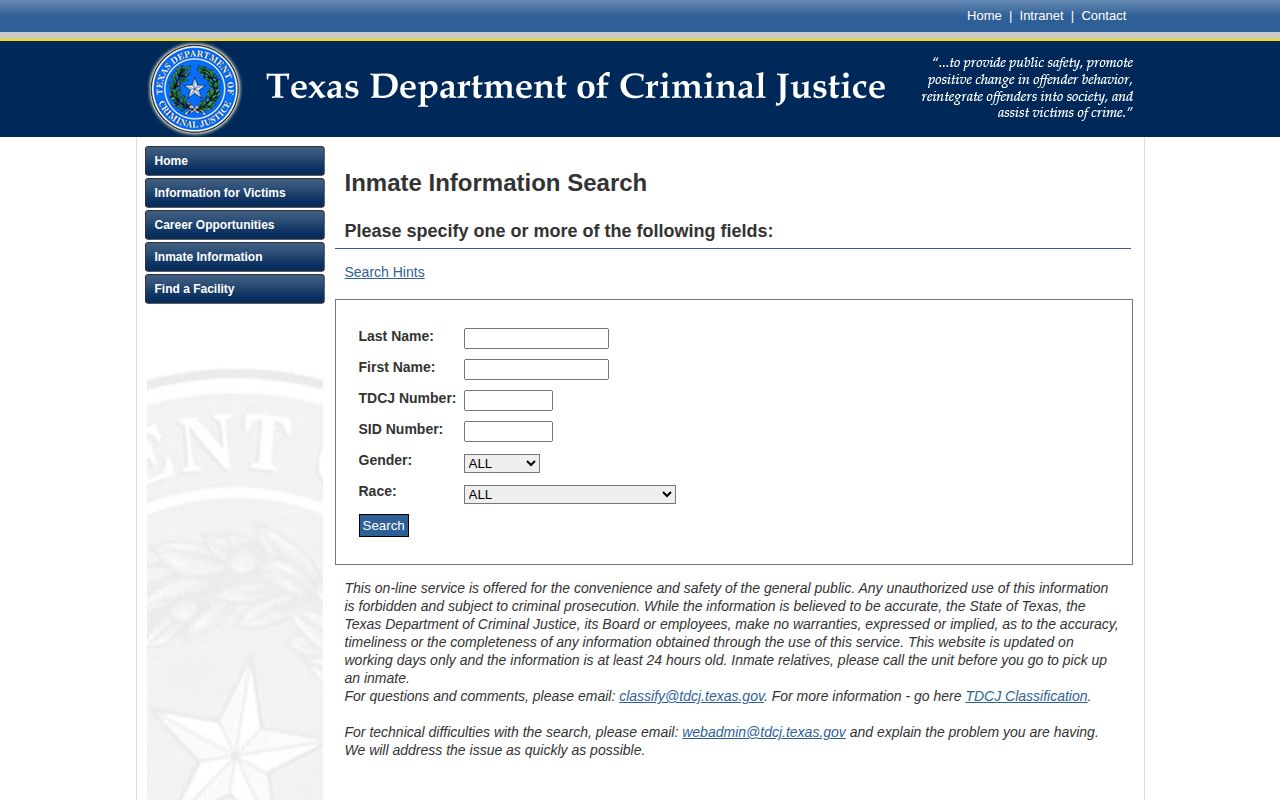
Reading the labels together prevents a review date or sentence endpoint from being reported as a completed release.
Older Cherokee TDCJ Release Records
The public web search is aimed mainly at people now in TDCJ custody. An older discharged person may no longer appear. TDCJ offers an official email information route at its inmate information page. Send the full name and TDCJ number to pia@tdcj.texas.gov. If the number is unknown, provide the exact date of birth, or approximate age and county of conviction. Ask for incarceration history, release or discharge date and type, and public supervision status.
TDCJ lists no charge for the basic information supplied through that channel. It does not provide photographs or Social Security numbers by this method. Housing at Skyview or Hodge does not mean Cherokee County was the county of conviction, so search the court file only where the underlying case was filed.
The official email instructions also define the projected date and show the information needed for a request.
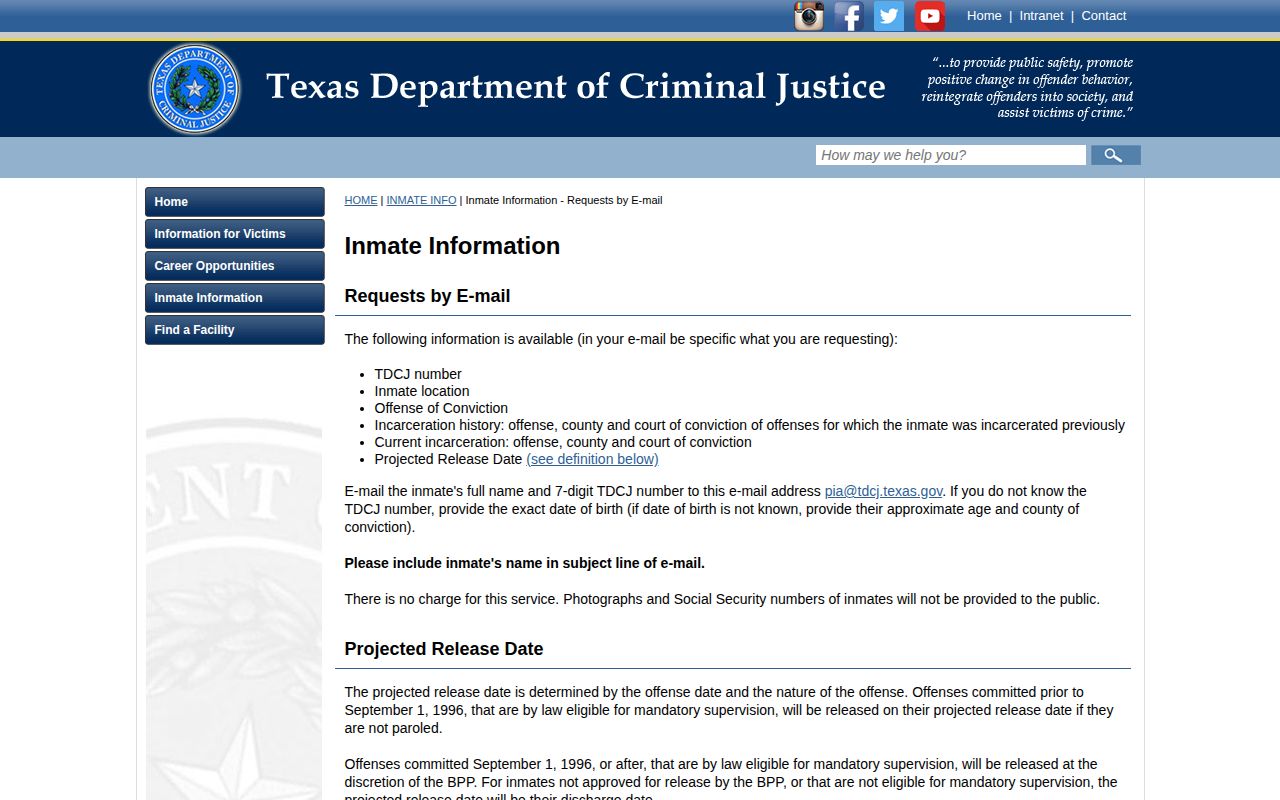
This fallback is the key official path when a completed state sentence has dropped from the current-inmate interface.
Cherokee Release Credits and Good Time
Texas Government Code chapter 498 governs state good-conduct time. Section 498.003 calls it a privilege, not a right, and says it does not reduce the sentence itself. Credit may affect classification or eligibility where another law permits, and it may be forfeited. Mandatory supervision can depend on calendar time plus eligible accrued credit, statutory exclusions, and discretionary BPP review.
Parole eligibility follows Government Code chapter 508. Offense date, offense type, sentence, special findings, and consecutive terms can change the formula. Eligibility opens a chance for review. It does not compel parole.
- Good-conduct time
- Credit that can affect eligibility or classification under state law but does not erase the sentence.
- Parole
- Discretionary release from prison to serve the balance under supervision.
- Mandatory supervision
- A statutory release path that may require BPP approval and excludes some cases.
- Discharge
- The end of the sentence or supervision obligation for that record.
Texas Release Date Rules Differ
Texas projected-date logic depends on the offense date. For certain eligible offenses before September 1, 1996, TDCJ explains that the projection can operate as mandatory release if parole has not occurred. For qualifying later offenses, mandatory supervision is discretionary and needs BPP approval. A denial or statutory exclusion can make discharge, rather than an earlier hoped-for date, controlling.
There is no universal Texas rule requiring every prisoner to serve 85 percent. Some serious offenses have strict flat-time rules, while others follow different statutes. The precise subsection and offense date must be checked. Cherokee County also publishes no rule promising an early Friday release when a date lands on a weekend or holiday. Obtain the actual time sheet or order and ask the custodian how that confinement is scheduled.
Cherokee County Jail Date Calculations
County jail time is not computed under TDCJ's classification system. Code of Criminal Procedure article 42.032 permits good-conduct commutation for eligible people serving county jail sentences under sheriff rules. A pretrial detainee cannot earn a bond release through TDCJ good time. Bond, dismissal, a judge's order, or a transfer determines that custody event.
For a sentenced county prisoner, ask Sheriff Records for the written good-time policy in force during the confinement and the person's existing time sheet. Obtain the signed judgment from the proper clerk, including sentence start, jail credit, and concurrent or consecutive language. If the dates differ from a simple calendar count, those records are stronger than an unsourced calculator.
A county request should seek an existing calculation rather than ask staff to create one. Include the booked name, booking number, cause, and confinement dates. Ask for the credit sheet, release order, literal release code, and receiving-agency field. A transfer to TDCJ marks the end of sheriff custody, not community release. Continue the timeline in the state system after intake.
The clerk record supplies the signed legal authority. Compare the judgment with the sheriff time sheet and preserve both source dates. When an order changes, the latest signed court document controls the sentence terms, while the jail transaction remains the best proof of when the physical handoff or release occurred.
No Cherokee-specific public good-time policy or weekend-release schedule was located as of August 2, 2026.
Why Cherokee Release Dates Change
A calculation can move for legal, custodial, or record reasons. Preserve the old check date and compare the full detail rather than copying only the new number.
| Factor | Possible effect |
|---|---|
| Credit or discipline | A corrected credit entry or forfeited good time may change eligibility or projection. |
| Court action | An appeal, modified judgment, new sentence, or corrected credit can alter the calculation. |
| Detainer or hold | One custodian may release the person directly to another authority. |
| BPP decision | Approval, denial, reconsideration, a future date, or a required program affects timing. |
| Sentence structure | Concurrent or consecutive terms and a new conviction can move the endpoint. |
If a projected date has passed while TDCJ still lists a facility, report that conflict and request updated calculation information. Do not declare release based on the older projection.
Confirm a Cherokee Actual Release
After a favorable parole vote, Review and Release Processing can address the processing stage. A vote may still depend on a program, approved residence, certificate, or hold. After physical departure, the TDCJ record and Parole Division establish whether the person entered parole or mandatory supervision rather than full discharge.
For county custody, call the Cherokee County Jail for a current check, then request the booking-and-release transaction from Sheriff Records. Ask for the release timestamp, literal code, code definition, and receiving agency. Pair a bond or sentence result with the court order. Texas IVSS-Counties may provide a fast notice, but the custodian's underlying record is stronger proof. The VINELink Check page explains the current Texas IVSS replacement and its notification limits.